Best Digital Asset Management Software in 2026
The best digital asset management software depends on team size, budget and what slows you down. Six DAMs compared, with honest tradeoffs.

The best digital asset management software depends on your team size, budget, and what slows you down most today. For a 3 to 20 person marketing or communications team in a mid-size organization, a lightweight, search-first DAM like Clipido usually does the job. Enterprise suites earn their price only when brand governance, global distribution, or deep workflows justify them.
- Clipido: search-first DAM for mid-size marcom teams that need findability fast, without enterprise overhead.
- Bynder: enterprise default with wide integrations; unpublished pricing, with reported entry around $15,000 per year.
- Canto: established mid-market DAM with strong AI search; unpublished pricing, third-party estimates around $6,000 to $12,000 per year at entry.
- MediaValet: enterprise-grade option built on Microsoft Azure, strong on security and data residency.
- Air: fast, visual DAM aimed at creative teams that live in shoots and version stacks.
- Frontify: brand-management-led platform for big brands in commerce; reported contracts run between $15,000 and $30,000 per year.
If you are new to the category, start with our plain-language explainer on what digital asset management is, then come back to this shortlist.
What "best" actually means
Most "best DAM" articles rank platforms by feature count. That tells you little about which one will work for your team. We looked at six criteria that decide whether a digital asset management platform actually gets used, based on public vendor documentation and comparison research such as Orange Logic's comparison guide and Research.com's DAM roundup.
- Findability and search. Can people find the right photo or document without knowing the filename? AI-powered visual search, text-in-image search, and people recognition beat folder structures for most teams.
- Sharing and permissions. Agencies, press, partners, and internal departments need controlled access: galleries, expiring links, and clear roles.
- Collecting new work. Photographers and agencies send files constantly. A good DAM gives them one upload path instead of email attachments and WeTransfer links.
- Metadata and taxonomy. Tags people actually use, not a taxonomy nobody maintains. (Our guide on DAM metadata and taxonomy covers how to set this up.)
- Pricing transparency. Some vendors publish prices; others only quote after a sales call. That affects how easily you can compare and get budget approved. As the CoSchedule comparison of DAM platforms points out, many DAM vendors are opaque about pricing, so it is wise to keep backup options in case your preferred one comes in over budget.
- Implementation effort. A DAM that takes six months to configure is a different purchase from one that works in weeks.
We did not test these platforms hands-on. This shortlist is documented research: official vendor pages, published comparison data, and honest tradeoffs. Where a competitor wins, we say so.
Clipido: search-first DAM for mid-size marcom teams
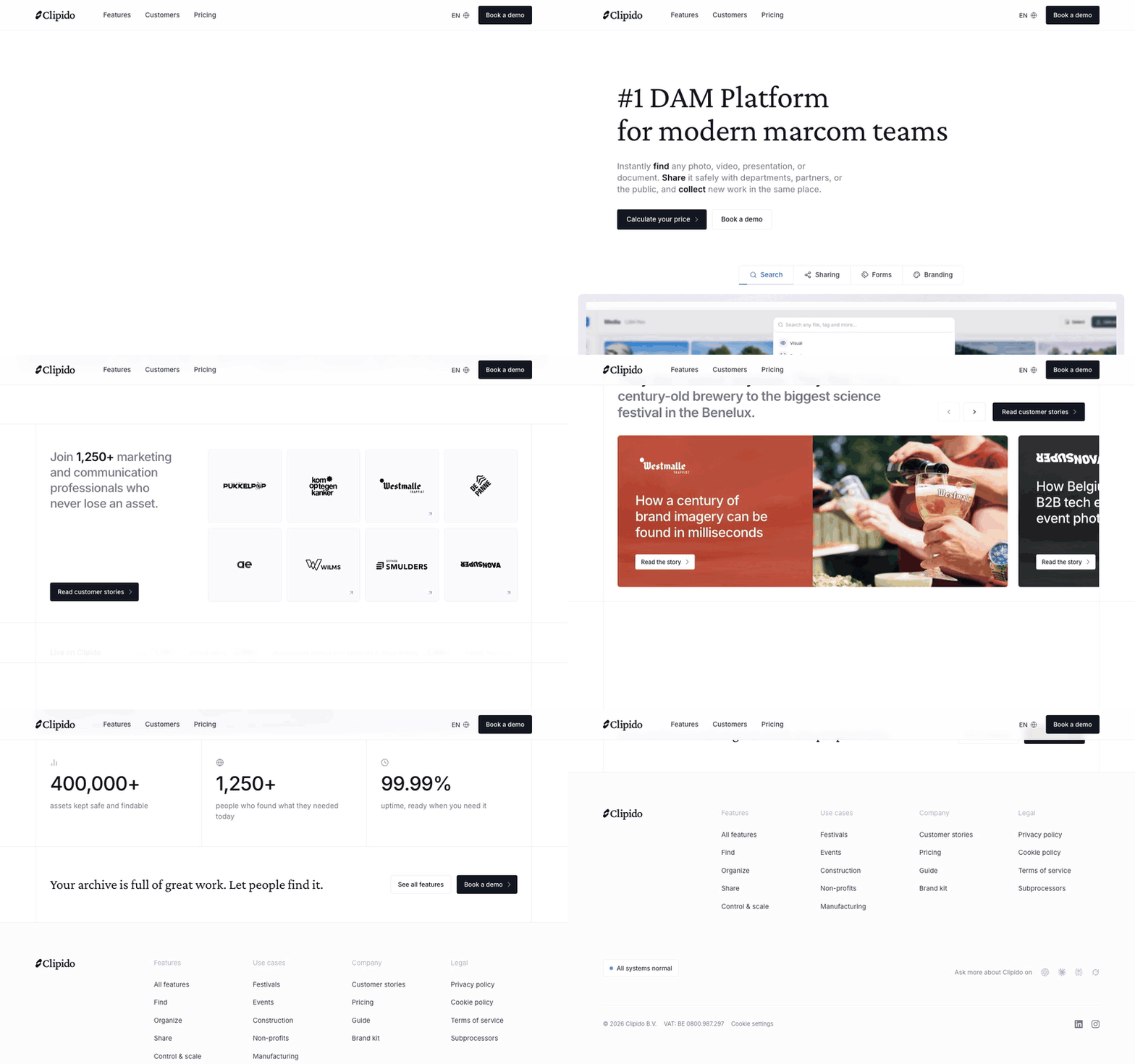
Scrolling through clipido.com, captured 20 October 2026
Clipido is built for marketing and communication teams that manage shared libraries of photos, videos, presentations, and documents. Its defining feature is search: you can find assets with visual search, search text inside images, search by people, and find visually similar files. That means a colleague can find "the photo of our CEO at last year's trade fair" without anyone having tagged it perfectly.
Where it fits the criteria:
- Findability: strong, and the core of the product rather than an add-on.
- Collecting: photographers, agencies, colleagues, and partners upload into one place, so new work stops arriving as loose attachments.
- Sharing: curated galleries and controlled workspaces for internal teams, agencies, press, customers, and other external recipients.
- Workflows: event photos can be distributed quickly to speakers, guests, partners, and social or marketing teams.
- Migration: fragmented archives from SharePoint, Google Drive, Dropbox, and local servers move into one library instead of five.
- Organization: metadata, tagging forms, workspaces, and archives replace folder-structure chaos.
Tradeoff: Clipido is deliberately lightweight. If you need deep creative workflow automation, templated content production, or a brand-guideline module, an enterprise suite does more. Its sweet spot is teams of roughly 3 to 20 people in organizations of 500 to 5,000 employees who need their library findable and shareable without a heavy implementation project.
If the mid-size, search-first description sounds like your team, talk to Clipido and book a demo. Bring your hardest search problem to the call: that is the fastest way to see whether any DAM, ours included, actually solves it.
Bynder: the enterprise default
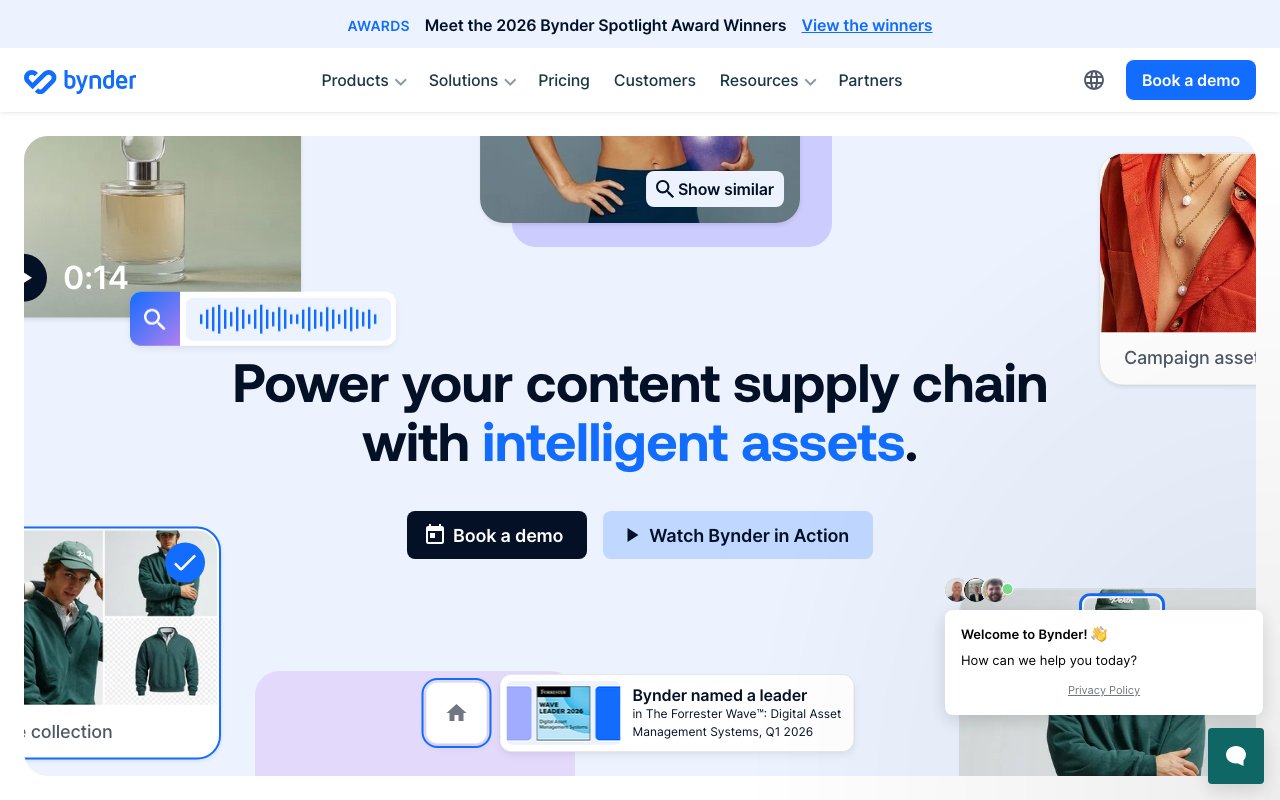
bynder.com, captured 20 October 2026
Bynder is one of the most established enterprise DAM platforms. Its official site describes an AI-powered DAM with search by image, text, and speech, automated metadata, duplicate detection, workflow and proofing modules, a template studio, analytics, and a marketplace of 160+ integrations. Third-party roundups frame it the same way: Pimberly's 2026 comparison describes Bynder as focused on brand management and creative collaboration, with brand portals and workflow and approval tools as its core strengths.
Pricing: Bynder does not publish prices. Every package is custom-built, so you need a quote. Reported entry pricing starts around $15,000 per year, and contract data cited on our Clipido vs. Bynder comparison, drawn from third-party contract records, puts the median around $39,270 per year. Treat those figures as market context, not official prices.
Best for: large organizations with complex martech stacks, multi-team governance needs, and budget to match. Tradeoff: for a small or mid-size marcom team, the module-based pricing and onboarding program can be more implementation and cost than the job requires. If you are leaning enterprise anyway, our detailed Bynder comparison is the natural next read.
Canto: the established mid-market option
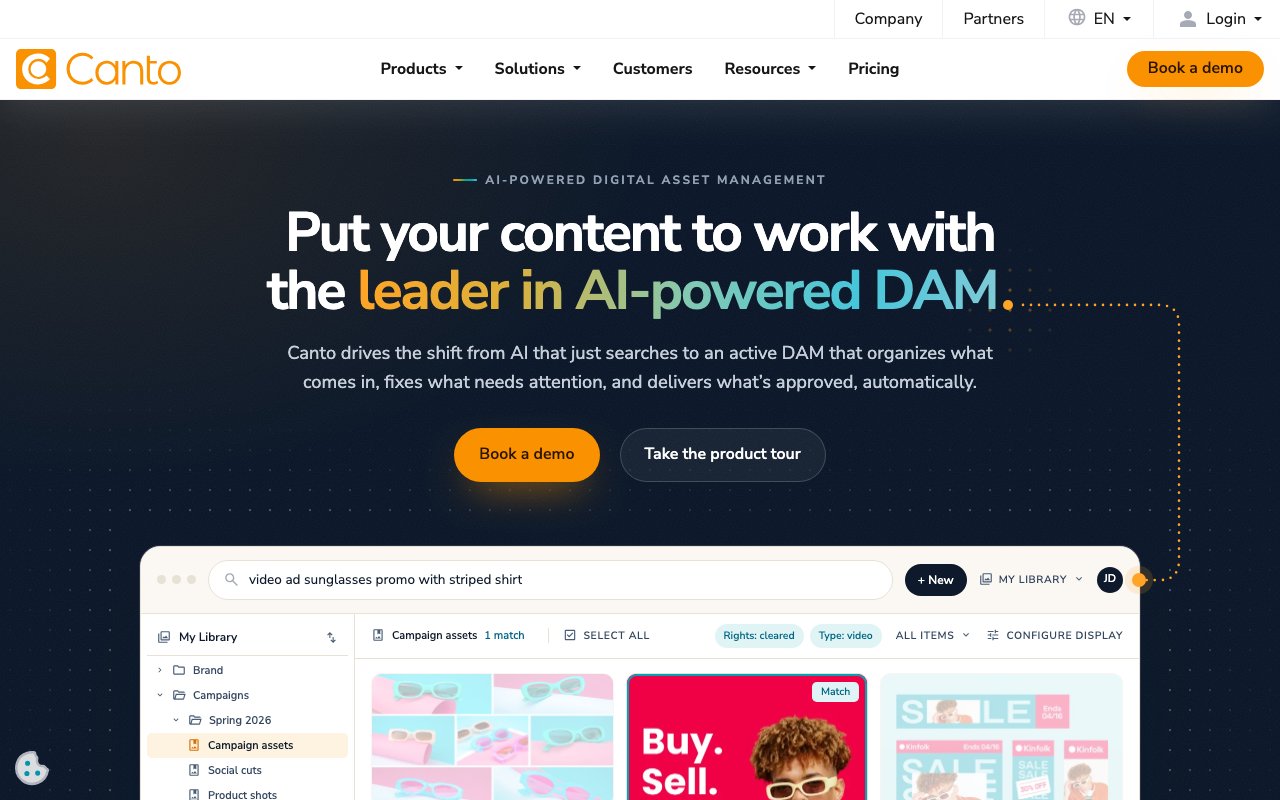
canto.com, captured 20 October 2026
Canto has been in DAM longer than almost anyone and now positions itself as an AI-powered platform that organizes, fixes, and delivers assets automatically. Official pages list AI visual search, facial recognition, natural-language search, approval and proofing workflows, brand portals, and unlimited share portals. Independent write-ups agree on where it sits: Pimberly's roundup calls Canto a flexible DAM for mid-market and enterprise teams with strong search and metadata tools and straightforward deployment.
Pricing: Canto's pricing page shows plan tiers (Core Essentials, Enhanced Collaboration, Omni Brand Solution, Advanced) but no figures. Third-party estimates cited on our Clipido vs. Canto comparison put entry pricing around $6,000 to $12,000 per year. Again: market context, not an official number.
Best for: mid-market teams that want an established platform with mature AI search and portals. Tradeoff: unpublished pricing makes comparing quotes harder, and teams that mainly need strong search and sharing may pay for workflow breadth they will not use.
MediaValet: enterprise-grade and Azure-native
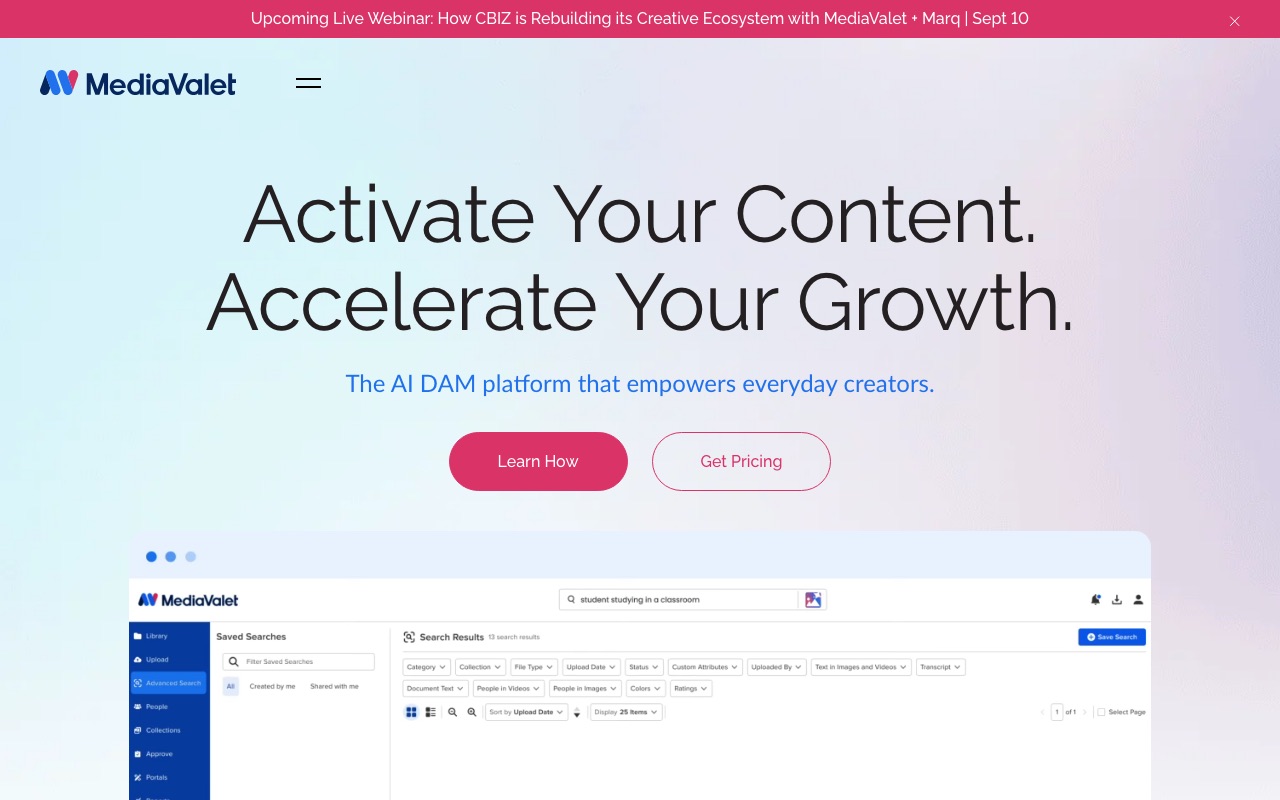
mediavalet.com, captured 19 August 2026
MediaValet is built entirely on Microsoft Azure, with a global network of data centers for data residency, and certifications including SOC 2, ISO 27001, HIPAA, and GDPR compliance. Official documentation highlights AI tagging, face recognition, natural-language image search, video transcription and scene detection, granular permissions, CDN delivery, and support for 300+ file types.
Best for: organizations where security, compliance, and data residency are procurement requirements, or that are Microsoft-centric. Tradeoff: it is an enterprise product with enterprise onboarding. A mid-size marcom team that mainly needs fast findability and simple sharing may find it more platform than the problem calls for.
Air: the creative team's fast lane
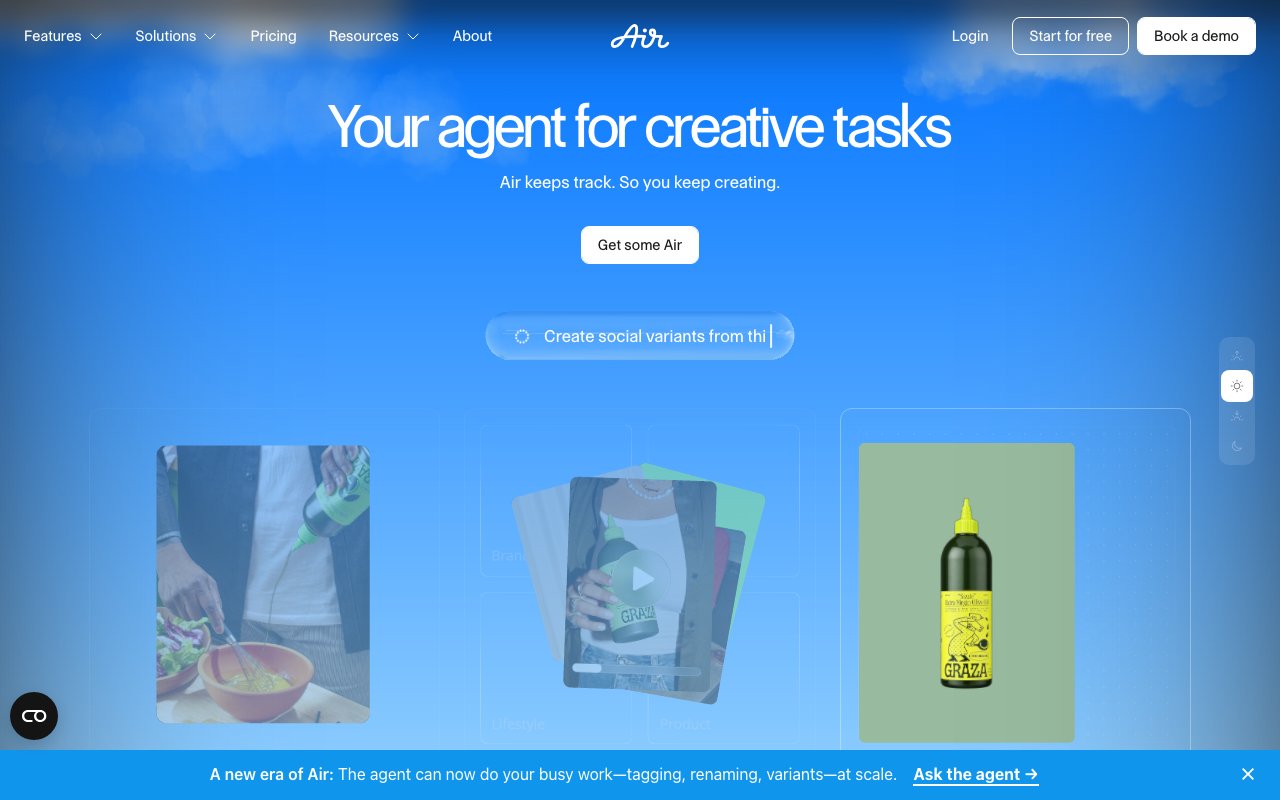
air.inc, captured 20 October 2026
Air targets visual-first creative teams. Its library uses boards instead of folder trees, so one asset can live in multiple campaigns without duplication. Official pages describe conversational search, smart tagging, OCR on text inside images, version stacking, automatic video transcripts, upload forms for collecting work from photographers and partners, and AI editing tools.
Best for: in-house creative studios and content teams that move fast, review constantly, and want AI-assisted editing built in. Tradeoff: its strengths are creative production speed and visual organization. For marcom teams whose main pain is a searchable, permission-controlled shared library for the whole organization, a search-first DAM focused on that job fits more directly.
Frontify: when brand governance comes first
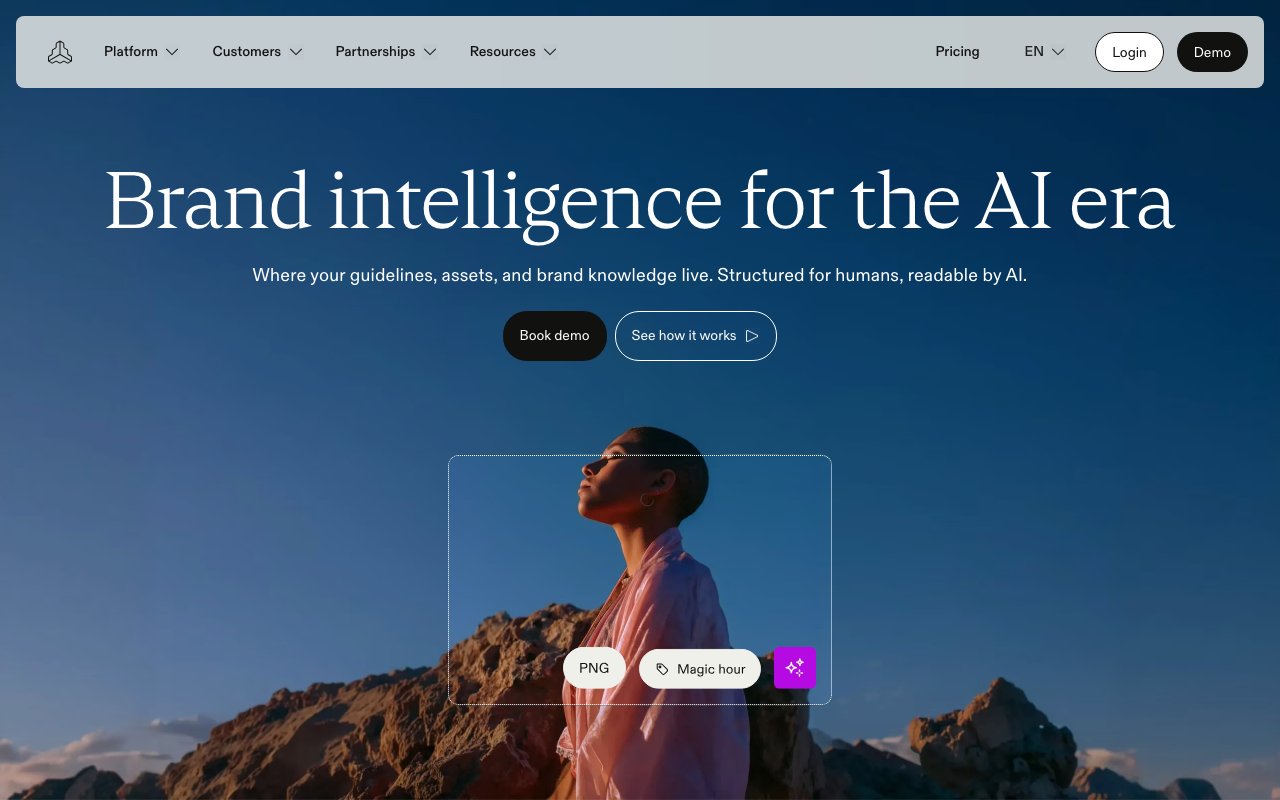
frontify.com, captured 20 October 2026
Frontify is a brand-management platform that includes DAM rather than a pure DAM. Official pages describe interactive, machine-readable brand guidelines, locked templates that let non-designers create on-brand content, granular permissions, approval workflows, CDN-based embedding, and integrations with Adobe Creative Cloud, Figma, Salesforce, and CMS platforms.
Pricing: Frontify does not publish prices. It is aimed at big brands in commerce, where annual contracts typically run between $15,000 and $30,000. As always in this category, treat that as market context and confirm with a quote.
Best for: multi-brand or multi-market organizations where the biggest problem is brand consistency, not asset findability. Tradeoff: if your core need is searching a decade of project photography or distributing event photos, a brand-system suite is the wrong tool to lead with.
How to choose: match the platform to your situation
- Your marketing team is 3 to 20 people in an organization of 500 to 5,000, and findability is the pain: a search-first DAM like Clipido is the likely fit.
- You need deep workflow automation, templating, and 100+ integrations with enterprise budget: Bynder.
- You want an established mid-market platform and are willing to negotiate on unpublished pricing: Canto.
- Security, compliance, and data residency drive the purchase: MediaValet.
- Your team is creative-first and drowning in versions and review cycles: Air.
- Brand governance across many brands or markets is the real problem: Frontify.
Two pitfalls to avoid. First, do not let a demo decide for you: vendors show polished scripted flows, so test with your own worst-case files, not theirs. Our full guide on how to choose a DAM gives you a requirements checklist and trial tests for exactly that. Second, model the total cost before committing, because quoted platform fees are only part of it; our guide on what digital asset management costs breaks down the five pricing models and real cost data. And because so many vendors hide their prices behind a sales call, keep at least one backup option in your shortlist, as CoSchedule's DAM selection guide recommends.
Frequently asked questions
Does Adobe have a DAM?
Adobe offers DAM capabilities through Adobe Experience Manager Assets in its enterprise Experience Cloud. It is powerful but priced and scoped for larger organizations; Pimberly's 2026 roundup notes it is typically best suited to organizations with dedicated IT and an Adobe ecosystem. Most mid-size marketing teams evaluate dedicated DAM platforms instead.
What is the difference between a DAM and a CMS?
A CMS manages content for a website. A DAM manages your underlying library of photos, videos, presentations, and documents, and feeds approved assets to the CMS and every other channel. You may need both, but they solve different problems.
How much does DAM software cost?
It varies widely. Lightweight tools can start in the hundreds of dollars per month, mid-market platforms often run from thousands to tens of thousands per year, and enterprise suites commonly reach five or six figures annually. For reference, Bynder reportedly starts around $15,000 per year, and Frontify contracts for large commerce brands typically fall between $15,000 and $30,000. Published prices are rare; see our pricing guide for the five pricing models and real examples.
