10 Bynder Alternatives To Choose From in 2026
10 Bynder alternatives for 2026, compared on published pricing, AI plans and real reviews. Includes when it's still worth staying with Bynder.

Bynder is a genuinely capable platform, and that's rarely where the search for an alternative starts. It usually starts with a demo that went well, a quote that arrived without a number attached, and the growing suspicion that you're being sold more governance than a six-person marketing team will ever configure.
Bynder alternatives are the digital asset management platforms teams evaluate instead, usually for one of three reasons: the price, which averages around $39,000 a year and is never published upfront; the module structure, where AI, workflow and analytics are separate line items on top of the core library; or the rollout, which Bynder's own onboarding team describes as two to four months of "training wheels." They split into two real brackets. One is enterprise-to-enterprise: Aprimo, Acquia DAM, Adobe Experience Manager Assets, built for the same governance Bynder sells, at a similar price. The other is lighter: published pricing, faster rollouts, no module structure. Clipido and a handful of others compete there.
This list covers both brackets, with real numbers where they exist and a plain "not published" where they don't. It also names the two or three situations where Bynder is still the right call, because a comparison that never concedes anything isn't a comparison. It's an advertisement.
What Bynder gets right, and where it costs you
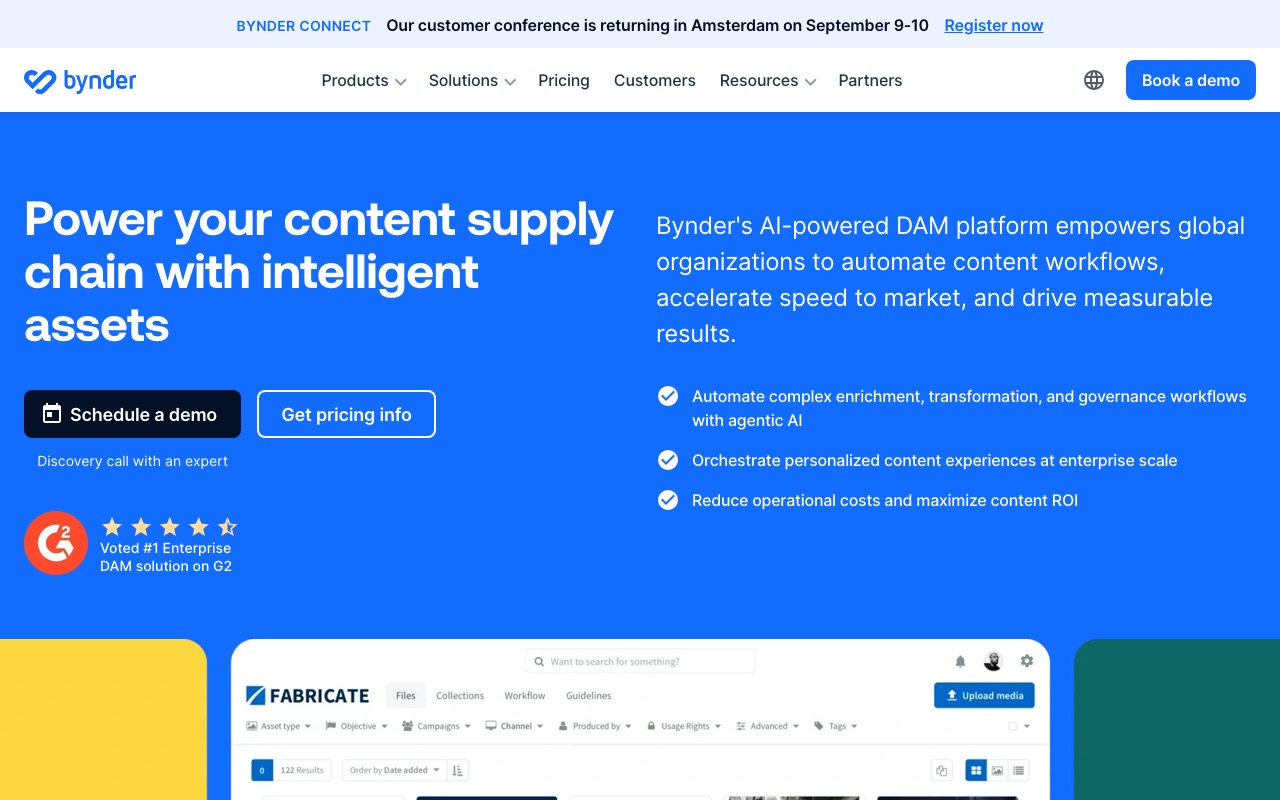
bynder.com, captured 19 August 2026
Start with the case for Bynder, because it's a real one. On G2, where Bynder holds a 4.5 out of 5 across 1,168 reviews, and on Capterra, where it holds the same 4.5 across 227, the single most-repeated praise is how fast the core library gets adopted: a guided setup, tagging and search that don't need folder navigation, weekly onboarding meetings reviewers describe as consistently well organized. Close behind is integration depth, particularly Adobe Creative Cloud and large-scale migrations. One reviewer mentions moving 180,000-plus assets across with Bynder's help.
Where it costs you is exactly where you'd expect: money and rigidity. Cost is the top complaint on both review platforms, and it's not abstract. One Enterprise reviewer describes adding a single extra admin as triggering a new licensing line and a full internal procurement cycle, just to give one more person access to the files everyone already uses. Missing features and a learning curve for anything past basic search tie for the second-most-cited complaint on G2, including specific frustration with AI search quality on non-obvious queries. And the rollout matches Bynder's own framing: G2's independently measured average is four months, in line with the "two to four months" Bynder's own community post calls training wheels.
None of that makes Bynder a bad platform. It makes it a platform priced and built for an organisation that will use the governance it's buying, and a worse fit for one that won't.
Two things are easy to miss in the pricing conversation, and it's only fair to say them: Bynder does offer a genuine self-serve trial at bynder.com/en/trial, and SSO ships free in every package rather than as an upsell. Both are areas where it's actually more generous than several lighter-bracket alternatives below, Clipido included.
Bynder alternatives at a glance
Feature
Pricing published on site
AI search in entry plan
Unlimited free viewers
SSO with no extra fee
EU/EEA hosting option
Rollout under 4 weeks
Included
Paid add-on, gated, or not publicly confirmed
Not available
Checked 19 August 2026 against each vendor's own pricing, help-center and security pages. 'Partial' covers a paid add-on, a tier-gated feature, or a claim that couldn't be confirmed from public sources — treated the same as a gap, not assumed in the vendor's favour.
1. Clipido
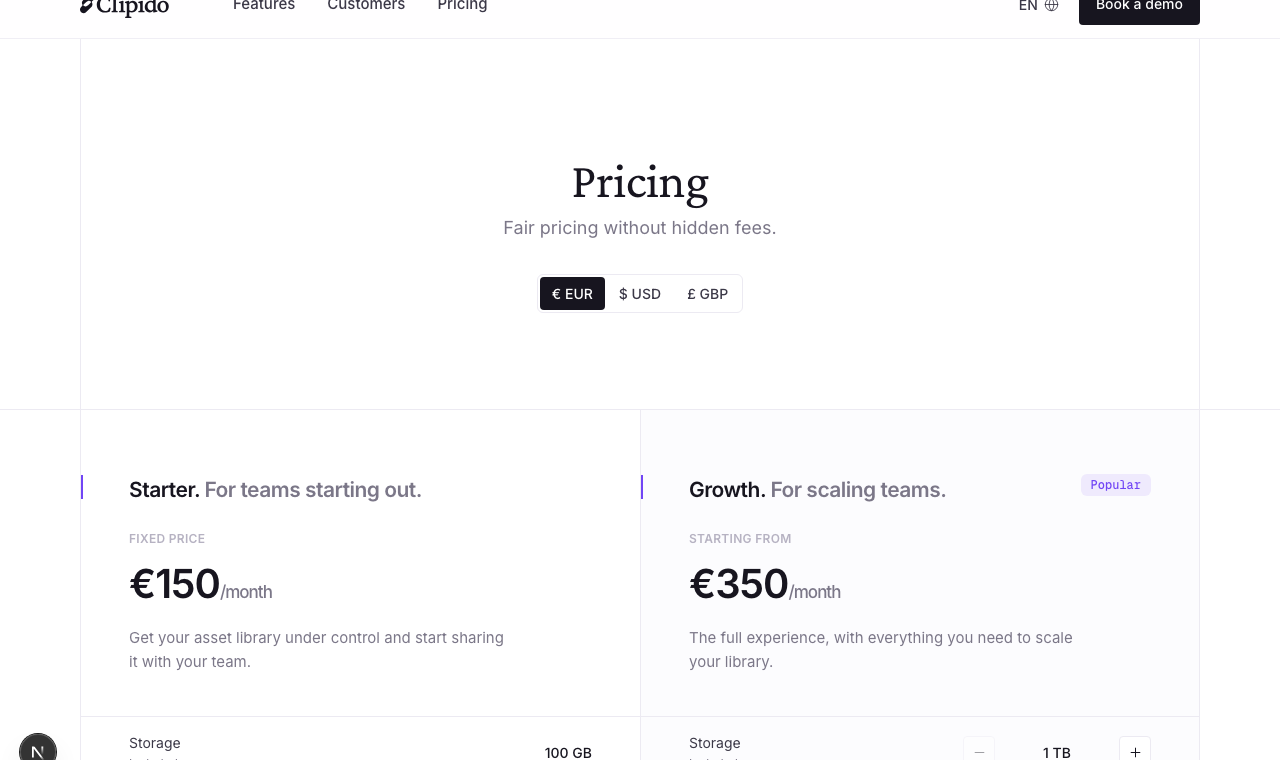
clipido.com/pricing, captured 18 August 2026
Clipido is a Belgian DAM built for marketing and communication teams who need people to find and share things, not a governance system nobody configures. Three things separate it from Bynder specifically, and they're all checkable.
AI search and visual search ship in the entry plan. At Bynder, AI is priced and packaged separately from the core DAM, so it's a line item to negotiate rather than something every customer already has. At Clipido, it's included from Starter, €150 a month, no upsell call required.
Viewers don't cost anything, ever. Bynder's three paid user tiers (heavy, regular, light) mean every reseller, journalist or event volunteer who needs read-only access is a line on the bill. Clipido's plans, Starter and Growth at €350 a month, both include unlimited free viewers.
Pricing is on the site, and the rollout is a specific, short claim rather than a range. Neither Bynder nor Canto publishes a single number anywhere; Clipido's is on the pricing page, and the team commits to going live in two weeks with its own staff, not a third-party implementation partner. That's Clipido's own stated timeline, not an independently audited one the way Bynder's four-month G2 average is, so weigh it accordingly. But it's a specific number, which is more than most of this list offers.
On hosting: the application, database and job queues run in Amsterdam, uploaded media sits in Google Cloud's Belgian region and Cloudflare's European region, and every sub-processor is named with its purpose and location on Clipido's subprocessors page, including the one place it doesn't fully clear its own bar: daily database backups are written to US-owned storage, encrypted, disclosed plainly rather than hidden. Bynder is itself Amsterdam-headquartered with real EU hosting and certifications to match, so this is a smaller edge against Bynder specifically than it is against a vendor with offices in Atlanta and Berlin. More on that below.
Two honest gaps, visible in the table above: there's no self-serve free trial, only a demo, and SSO is a paid add-on rather than bundled into every plan. Bynder beats Clipido on both of those specifically.
The other alternatives
2. Frontify
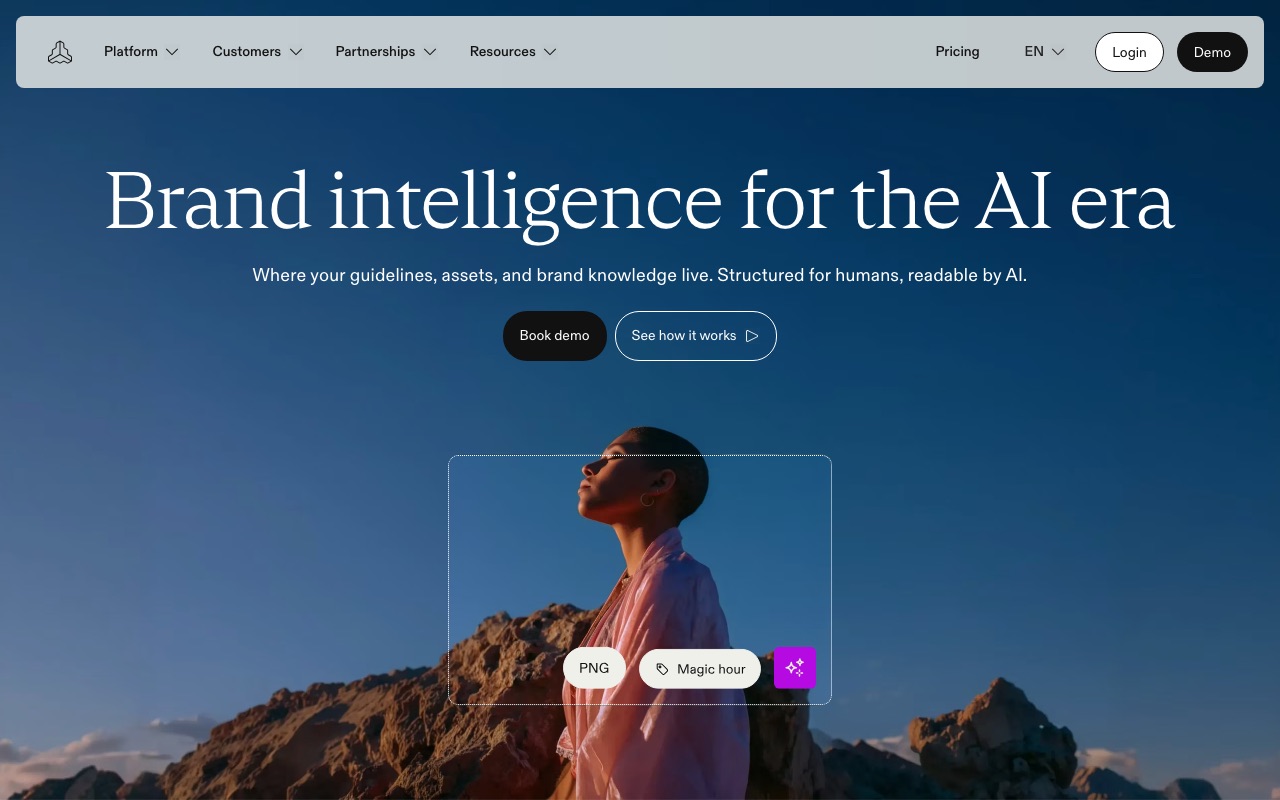
frontify.com, captured 19 August 2026
Frontify leans toward brand guidelines and governance rather than deep asset management: living style guides, an AI "Brand Assistant" trained on your own brand rules, and a large asset library underneath. It's the strongest pick on this list if enforcing the brand matters more than managing the library, and Capterra reviewers give it 4.8 out of 5, the highest rating here, though on a small base of 82 reviews. The catch: no public pricing tiers exist at all, only a "monthly active users" model that counts every logged-in external contributor, so a Frontify quote can move a lot depending on how many agencies and franchisees touch it. Vendr's measured contracts land at a $32,386 median.
3. Aprimo
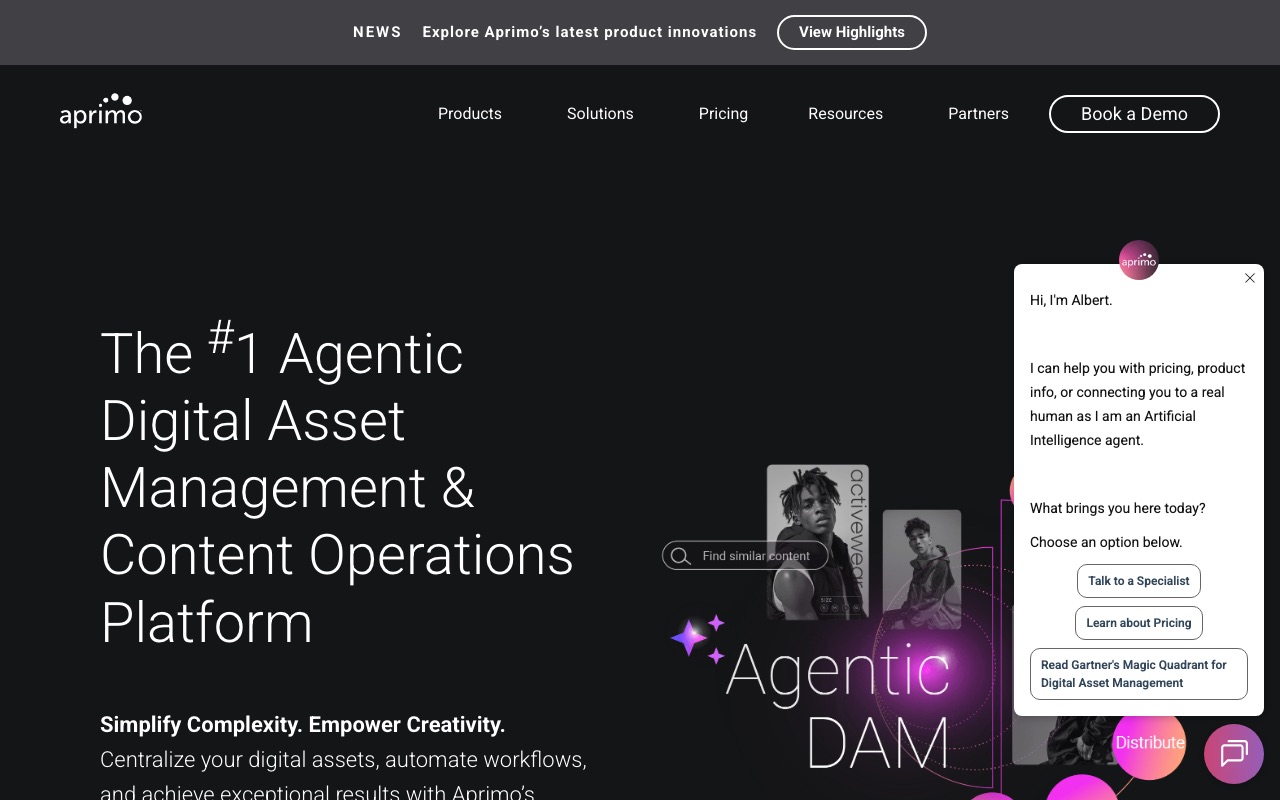
aprimo.com, captured 19 August 2026
Aprimo ties DAM into campaign budgeting and work approvals as one platform, and it plays at enterprise scale: a Forrester Wave leader for 2026, an on-premise option most of this list doesn't offer, and a Belgian pedigree of its own (it acquired Ghent-based ADAM Software for its DAM technology back in 2017). Capterra lists a starting price of $20,000 a year; Vendr's measured median is closer to $50,000. Reviewers consistently flag a steep learning curve and a real dependence on Aprimo's paid onboarding service to get full value.
4. Acquia DAM (formerly Widen)
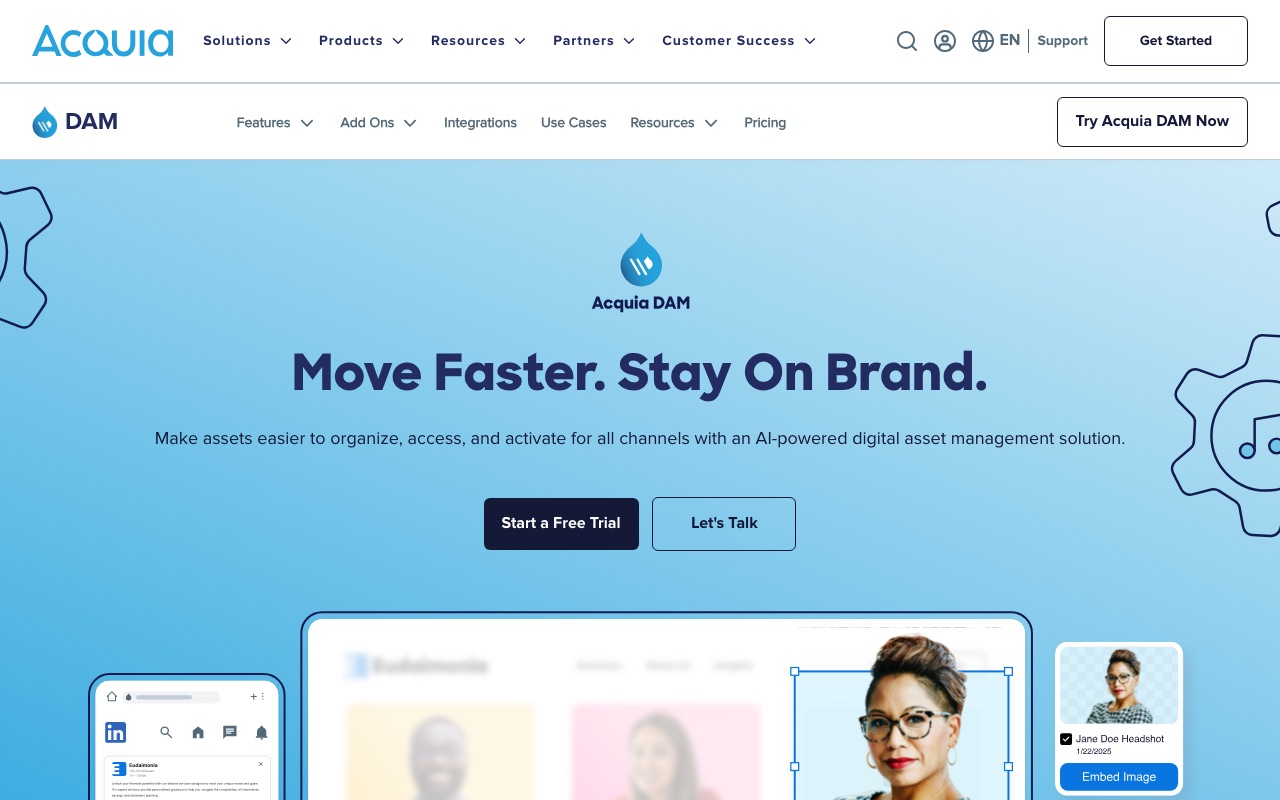
acquia.com/products/acquia-dam, captured 19 August 2026
Acquia DAM, formerly Widen before Acquia's 2021 acquisition, is the pick when assets need to plug into a PIM, a CMS or a retailer syndication pipeline: it ships a dedicated product-content module and close to 300 integrations. Vendr's measured contracts average $36,500 a year. Reviewers rate it 4.4 on both G2 (631 reviews) and Capterra (323 reviews), consistently praising ease of use, with the sharpest recurring complaint being performance on large asset libraries.
5. Canto
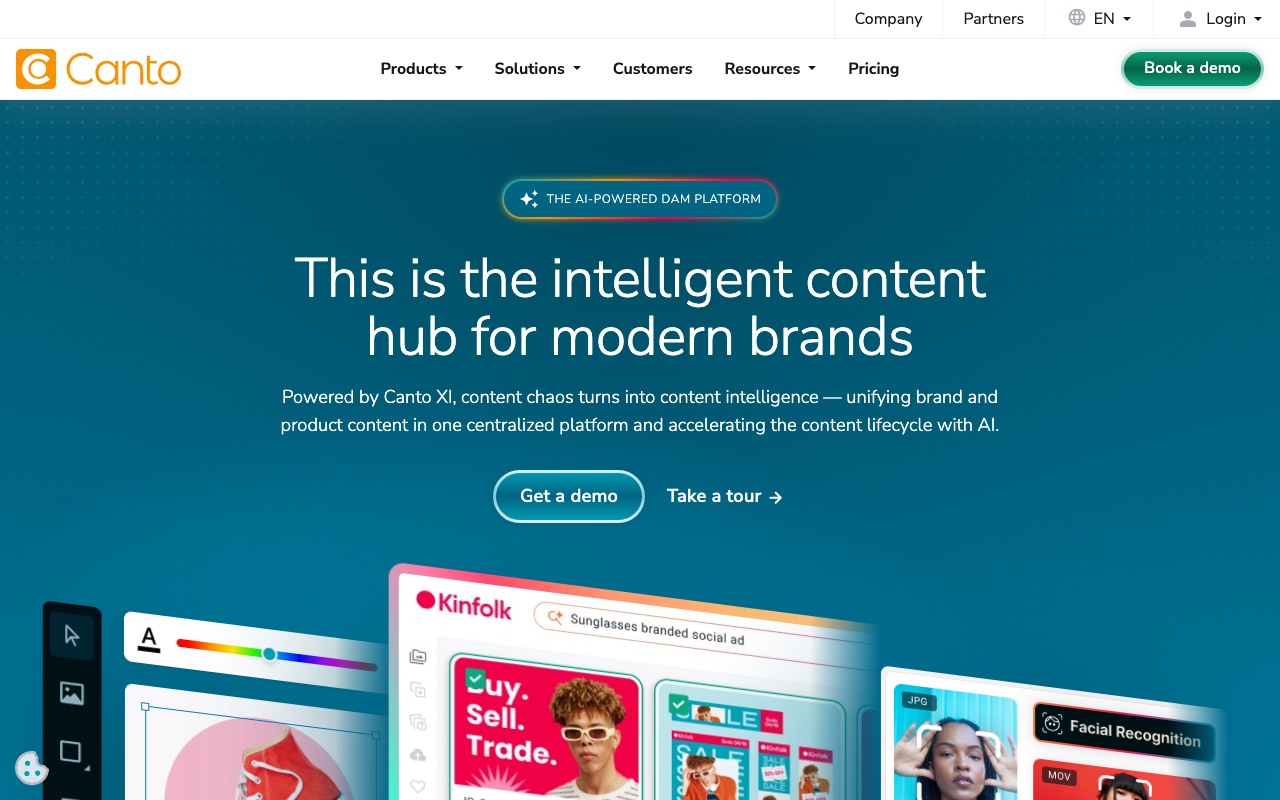
canto.com, captured 19 August 2026
Canto covers brand assets and product content in one system and is the closest like-for-like alternative to Bynder on scale, with 1,774 G2 reviews at 4.4. It doesn't publish prices either; a third-party estimate puts entry contracts around $6,000 to $12,000 a year, though Canto's own AWS Marketplace listing shows a real $25,000 for a 2TB, five-power-user bundle, a better sense of what a working deployment actually costs. AI search is a second-tier feature here too, not included from the start, and reviewers' single most-repeated complaint is search reliability despite the AI marketing.
6. Brandfolder
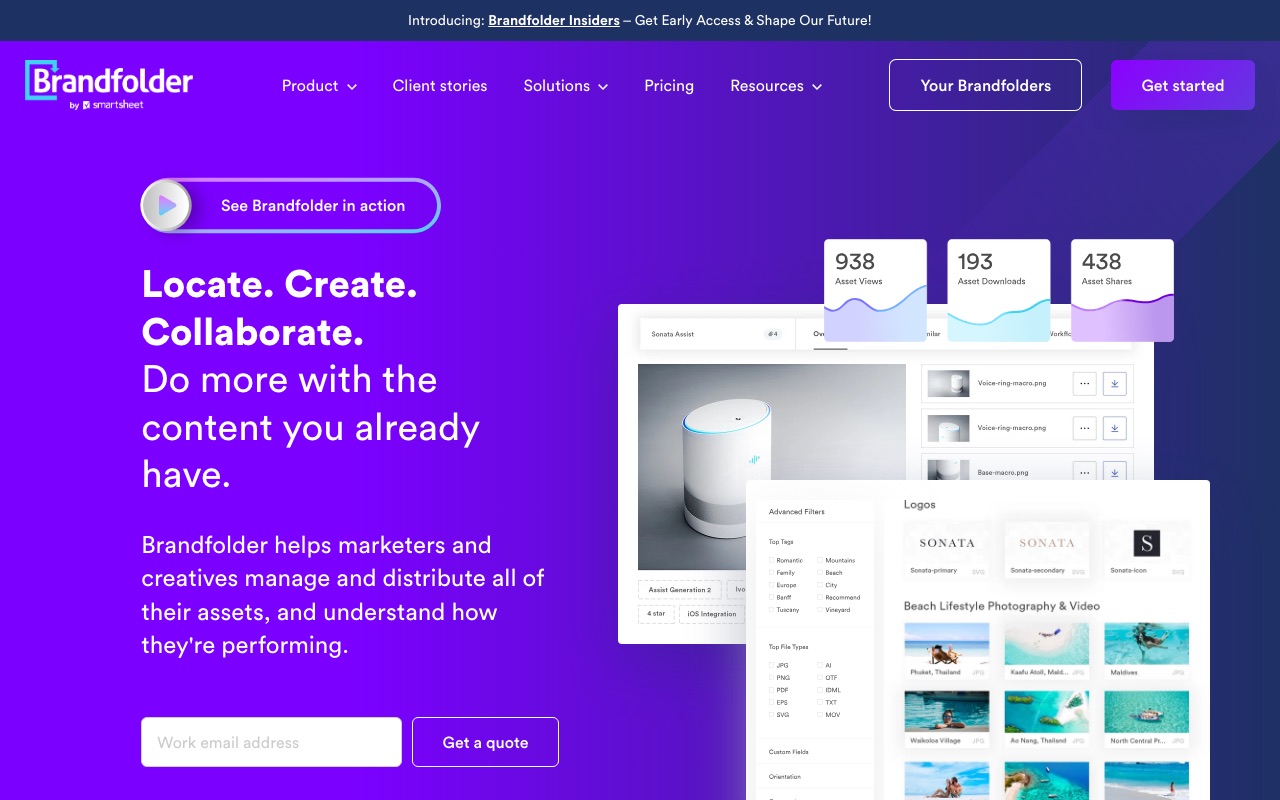
brandfolder.com, captured 19 August 2026
Brandfolder, now "Brandfolder by Smartsheet" after a 2020 acquisition, leans into distribution: custom portal links for retailers and partners rather than internal governance. It's the highest-rated of this group on Capterra, 4.7 out of 451 reviews, and Vendr's measured median sits at $24,682 a year, the cheapest of the enterprise-bracket options here. There's no confirmed European office or EU-specific data residency, since compliance now runs through the Smartsheet parent platform rather than a Brandfolder-specific one.
7. MediaValet
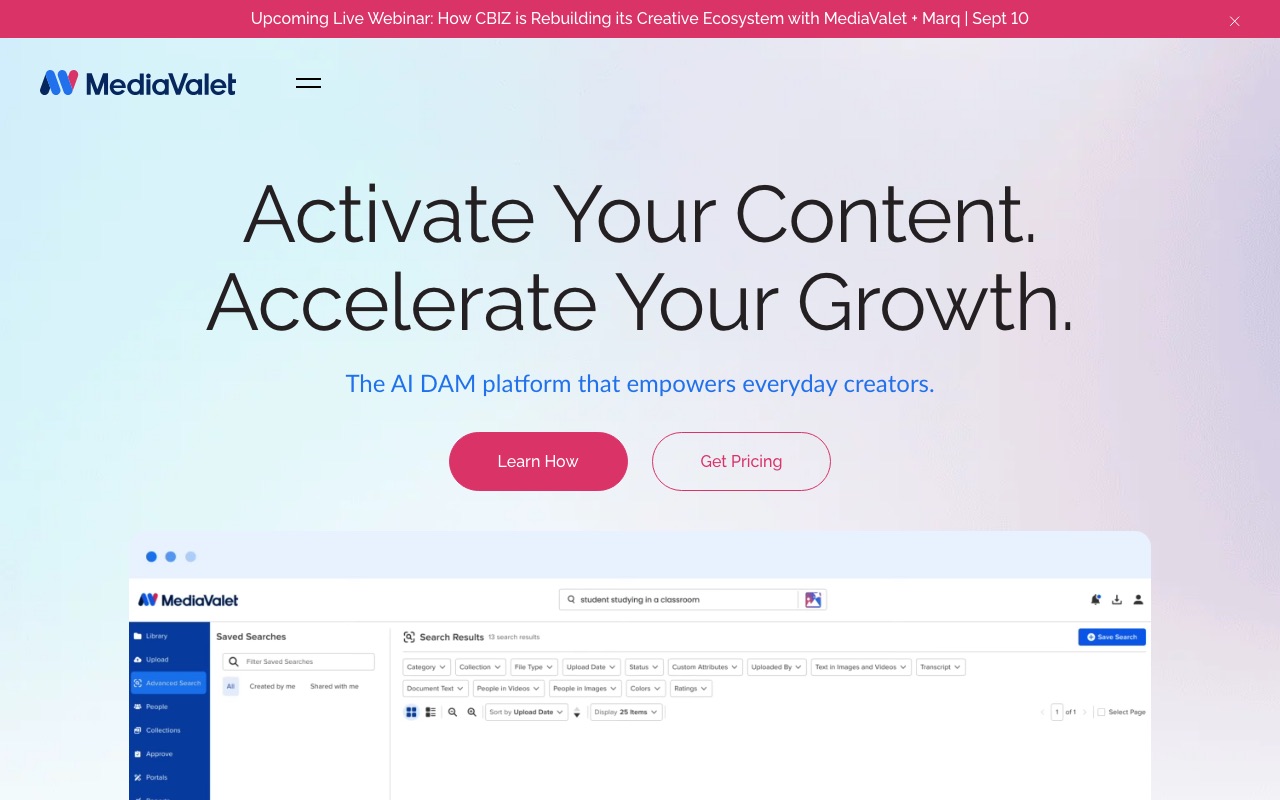
mediavalet.com, captured 19 August 2026
MediaValet is the answer for an IT department already standardised on Microsoft Azure: it runs exclusively on Azure infrastructure, can be paid for out of an existing Azure spend commitment, and plugs natively into SharePoint. It doesn't publish prices, and no third-party contract data exists for it either. Reviewers repeatedly praise support quality and call out a dated interface as the main weakness.
8. Filecamp
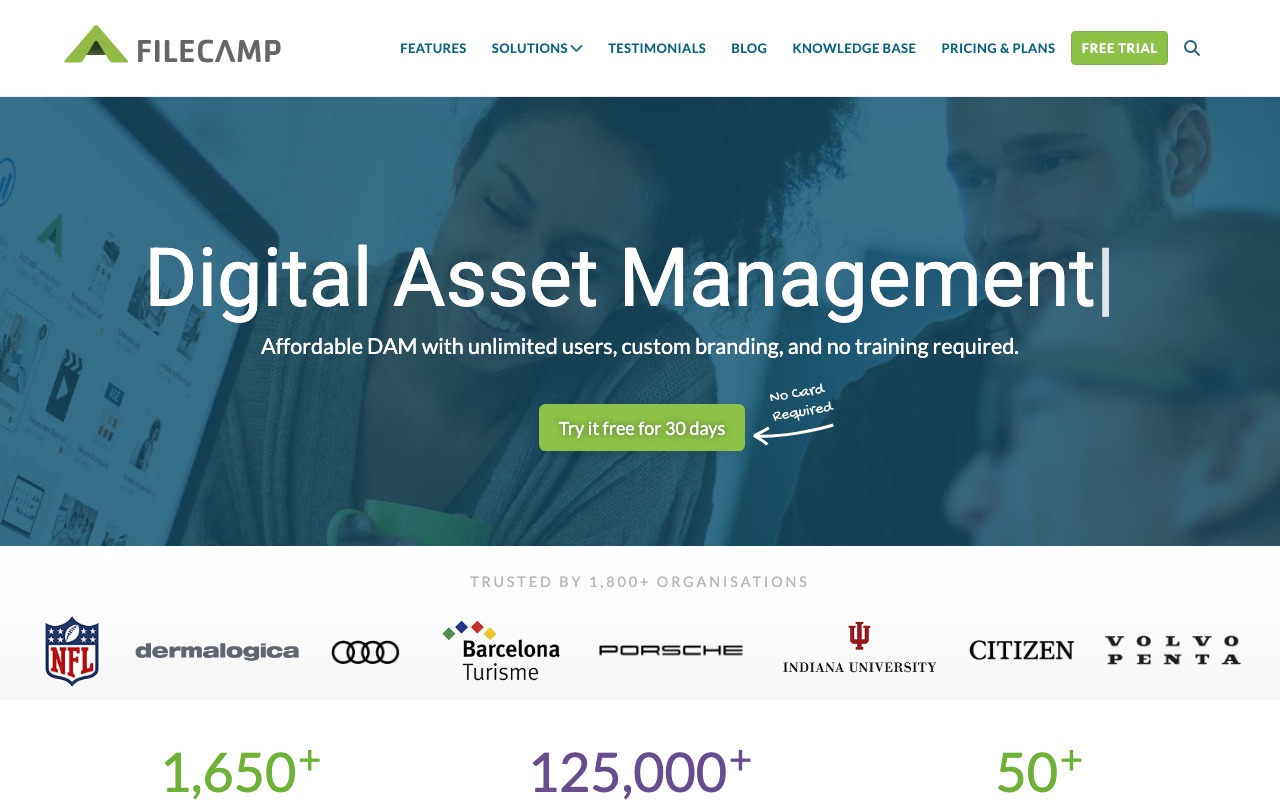
filecamp.com, captured 19 August 2026
Filecamp is the closest thing here to Clipido's own bracket: flat, published pricing from $29 a month, unlimited users on every tier, and a Capterra rating of 4.7 across 114 reviews. The tradeoff is where AI sits: auto-tagging only starts at the second tier, and there's no natural-language or visual search at all. It's a lean option for a small creative team on a fixed budget who doesn't need AI search specifically.
9. Dash
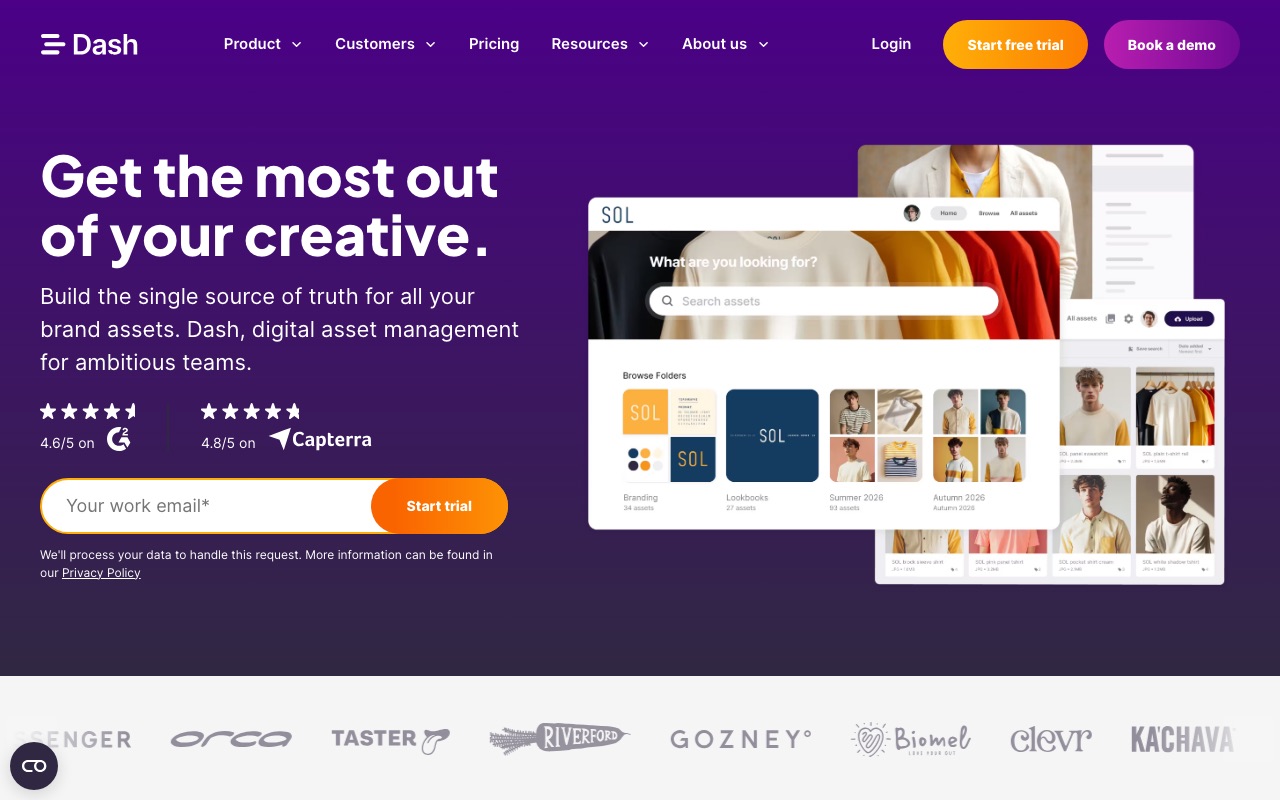
dash.app's own product screenshot, captured 19 August 2026
Dash is the closest peer to Clipido on this list: flat, published pricing from £79 a month (roughly $109), unlimited users on every tier with no feature gated behind a higher plan, and a Capterra rating of 4.8 across 92 reviews, tied with Frontify for the highest here. What it doesn't publish is an implementation timeframe, and its own marketing pages don't agree with each other on Bynder's ROI timeline (12 months on one page, 1 month on another), so weigh any speed claim from either side with a raised eyebrow. It's UK-based (Brighton), with EU hosting in Ireland but no confirmed presence on the European mainland.
10. Adobe Experience Manager Assets
business.adobe.com timed out on every capture attempt today — no screenshot could be taken
Adobe Experience Manager Assets is the pick for organisations already committed to the wider Adobe Experience Cloud stack, not just Creative Cloud: it's a module alongside AEM Sites and AEM Forms, with agentic AI search and Firefly-powered asset generation built in. Capterra's 4.4 rating (153 reviews) covers the whole AEM family, not Assets alone, and reviewers converge on the same two points as most enterprise DAMs in this bracket: real governance power, and a rollout measured in months, not weeks, that needs a dedicated AEM developer rather than a marketing admin to configure.
When you should stick with Bynder
A fair list names the cases where switching is a mistake, so here are three, plainly.
You run multiple brands or markets with formal approval chains. Bynder's modular Content and Asset Workflow tools are built for exactly this, and so is Acquia DAM's product suite. Clipido isn't built for multi-brand governance at that depth, and neither is most of the lighter bracket above.
Your assets feed a product content chain. If the DAM has to sit between a PIM and a retailer syndication pipeline, Bynder and Acquia DAM (with its dedicated Entries module) are the two names on this list actually built for that, not adapted to it.
Procurement requires a certificate, not a dossier. Bynder holds SOC 2 Type II, ISO 27001:2022, ISO 27018:2019 and ISO 22301:2019. So do several others here: Canto, Frontify, Aprimo and MediaValet all carry SOC 2 or ISO 27001 in some form. Clipido doesn't hold either certification. It offers security documentation for IT and legal review on request, which satisfies most due diligence, but if your procurement process hard-requires the certificate itself before a contract can be signed, that's a real limit worth knowing before the shortlist, not after it.
Outside those three, the calculation usually tips toward the lighter bracket. Our checklist for choosing a DAM walks through how to tell which situation you're actually in before you sit through another round of demos.
Frequently asked questions
Who are Bynder's main competitors?
At the enterprise end: Aprimo, Acquia DAM (formerly Widen) and Adobe Experience Manager Assets, all built for similar multi-brand governance at a similar price. In the lighter, published-pricing bracket: Clipido, Frontify, Canto, Brandfolder, MediaValet, Filecamp and Dash, among others, each with a different specific angle rather than one being a straight swap for another.
Does Bynder use AI?
Yes, extensively: AI-assisted search, tagging, image similarity matching and compliance checks are all real, current parts of the platform. What matters at the quote stage is that AI is priced and packaged separately from the core DAM rather than bundled into a base plan, so it's worth confirming which tier includes it before assuming a demo feature is included.
Is Bynder a good company?
By the numbers, yes: a 4.5 out of 5 on both G2 (1,168 reviews) and Capterra (227 reviews), with fast onboarding and integration depth as the most repeated strengths. The most consistent complaints are cost, which reviewers describe as rigid and prone to escalating with small changes, and a learning curve on anything past basic search.
What is the difference between Cloudinary and Bynder?
They're not really direct competitors. Bynder is a marketer-facing DAM built around a library, tagging and approval workflows. Cloudinary is developer-first media infrastructure, an API and CDN for transforming and delivering images and video at scale, with a separate, quote-based DAM module bolted on for teams that want a library on top of it.
What companies use Bynder?
Bynder states it's used by more than 4,000 brands, including Puma, Spotify, TED and Five Guys, and was named a Leader in Gartner's November 2025 Magic Quadrant for DAM. It's an established platform, most often chosen by organisations with multiple brands, markets or a product-content pipeline to govern.
